Unlock the Secrets of Iridology Reading: A Comprehensive Guide
July 19, 2025
Lectură de iridologie-Have you ever wondered how theeyecan reveal insights about your overallhealth? Iridology is a fascinating practice that examines the patterns and colors of the iris to assess systemic well-being. This non-invasive method uses detailed iris charts, mapping over 60 zones that correspond to specific organs and systems in thehuman body.
Originating in the 19th century, this technique has evolved into a moderntoolused by practitioners worldwide. While it lacks scientific validation, many believe it offers valuableinformationabout potential health imbalances. Unlike clinical diagnostics, iridology is gentle and focuses on prevention rather than treatment.
In this guide, we’ll explore the techniques, claimed benefits, and scientific debates surrounding this practice. Whether you’re a healthcare professional or simply curious, this comprehensive overview will provide you with a deeper understanding of how theeyeconnects to thebody.
Taxe cheie
Iridology analyzes iris patterns to assess systemic health.
It uses non-invasive methods with detailed iris charts.
Over 60 zones in the iris correspond to specific organs.
The human eye holds more secrets than meets the eye. Iridology is the study of theirisand its pigmentation abnormalities to assess health. This practice has been used for centuries to identify potential imbalances in thehuman body.
Elementele de bază ale iridologiei
Iridologists examine theirisfor patterns, colors, and marks. These features are believed to reflect the state of various organs and systems. Modernchartsdivide the iris into over 60 zones, each corresponding to a specific part of the body.
History and Origins of Iridology
The practice dates back to the 19th century. Ignazvon Peczely, a Hungarian physician, developed the first iris chart in 1880. He observedchangesin an owl’s iris after it suffered an injury. Later, Nils Liljequist expanded on this work, linking iris patterns to anatomical structures.
Cum funcționează iridologia
Iridologists use tools like magnifiers and slit lamps to analyze theiris. They follow bilateral mapping, where the right iris reflects the right side of the body, and the left corresponds to the left. Over time, practitioners track pigmentchangesto monitor health trends.
A 1957 Germanstudyanalyzed 4,000 iris photos but yielded inconclusive results. Despite this, many continue to find value in this holistic approach.
Zona Iris
Corresponding Organ
Sus dreapta
Brain
Lower Left
Ficat
Center
Inima
Inelul exterior
Piele
Techniques Used in Iridology Reading
The iris is a window into the body’s health, offering clues through its unique patterns. Iridologists use specialized tools and methods to examine this delicate part of the eye. By analyzing its colors, marks, and zones, they gain insights into systemic health.
Examining the Iris: Tools and Methods
To study the iris, practitioners rely on tools like 10x magnifiers, flashlights, and DSLR cameras with macro lenses. These devices help capture detailed images of the eye’s structure. Digital photography has become a standard, offering clearer visuals compared to analog methods.
Iridologists also use slit lamps for precise examination. This allows them to observe subtle changes in the iris’s texture and color. These tools ensure accuracy in identifying potential health concerns.
Understanding Iridology Charts
Iridology charts are essential for mapping the iris. They divide the eye into over 60 zones, each linked to a specific organ or system. For example, the liver zone is located at the 6 o’clock position, while the lymphatic system is near the limbus.
Grafic de iridologie Graficul drept -Iridologie Grafic -Ochi drept
Ringlects Health Health Lângă articulațiile, includ genunchii, șoldurile, coatele și umerii.
Ora 3 - ora 4
Dreapta sus spate
Corespunde coloanei vertebrale, sănătății coloanei vertebrale, alinierii și flexibilității.
Ora 4 - ora 5
Vezica dreaptă
Sistemul urinar de linie de apel și sistemul urinar din partea dreaptă.
Ora 5 - ora 6
Dreapta pelvină
Singurpresents a lăsat colonul, intestinul subțire și sănătatea digestivă.
Ora 6 - ora 7
Abdomen drept inferior
Fluxuri de apel la rinichi stânga, concentrat pe filtrare, detoxifiere și echilibru de lichide.
Ora 7 - ora 8
Abdomen superior drept
Fugele de apel stomac și organele digestive pe partea stângă.
Ora 8 - ora 9
Toraxul drept
Corespunde ficatului din partea stângă, detoxifierii responsabile și producției biliare.
Ora 9 - ora 10
Plămânul drept
Sunător de sunet Inima din stânga, sănătatea și circulația cardiovasculară afectată.
Ora 10 - ora 11
Gâtul drept
Funcții de fflexe de apel stâng, sănătate respiratorie și funcție BREA.
Ora 11 - ora 12
Creierul drept
Corespunde creierului emisferei stângi, sănătății mintale și funcțiilor cognitive.
Ora 12 - ora 1
Creierul drept
Corespunde creierului emisferei stângi, sănătății mintale și funcțiilor cognitive.
Graficul de iridologie Ochiul stâng - grafic de iridologie - ochi stâng
ochi stâng reflectă partea stângă corp.
Poziția ceasului (ochiul stâng)
Corespunde organului/sistemului
Detalii
Ora 1 - ora 2
Gâtul stâng
Corespunde organelor de reproducere corecte, includ uter, ovare (femei) sau testicule (masculin).
Ora 2 - ora 3
Lung stânga
Ringlects Health Health Drept, includ genunchii, șoldurile, coatele și umerii.
Ora 3 - ora 4
Thorax stânga
Corespunde coloanei vertebrale, sănătății coloanei vertebrale, alinierii și flexibilității pe partea dreaptă.
Ora 4 - ora 5
Abdomen superior stâng
Sistemul urinar de linie de apel și sistemul urinar din partea stângă.
Ora 5 - ora 6
Abdomen inferior stâng
Sună prezentă colonul drept, intestinul subțire și sănătatea digestivă.
Ora 6 - ora 7
Stânga pelvină
Rinichiul de rinichi drept, concentrat pe filtrare, detoxifiere și echilibru de lichide.
Ora 7 - ora 8
Stânga inferioară spate
Ineltele de apel stomac și organele digestive pe partea dreaptă.
Ora 8 - ora 9
Stânga sus în spate
Corespunde ficatului din partea dreaptă, detoxifierii responsabile și producției biliare.
Ora 9 - ora 10
Gâtul stâng
Regherpreses Inima din partea dreaptă, sănătatea și circulația cardiovasculară afectată.
Ora 10 - ora 11
Fața stângă
Funcția de fluxuri drepte, sănătatea respiratorie și funcția BREA.
Ora 11 - ora 12
Cerebrul stâng
Corespunde creierului emisferei drepte, sănătății mintale și funcțiilor cognitive.
Ora 12 - ora 1
Cerebrul stâng
Corespunde creierului emisferei drepte, sănătății mintale și funcțiilor cognitive.
These charts help iridologists interpret the iris’s features systematically. By referencing these zones, they can pinpoint areas of concern and track changes over time.
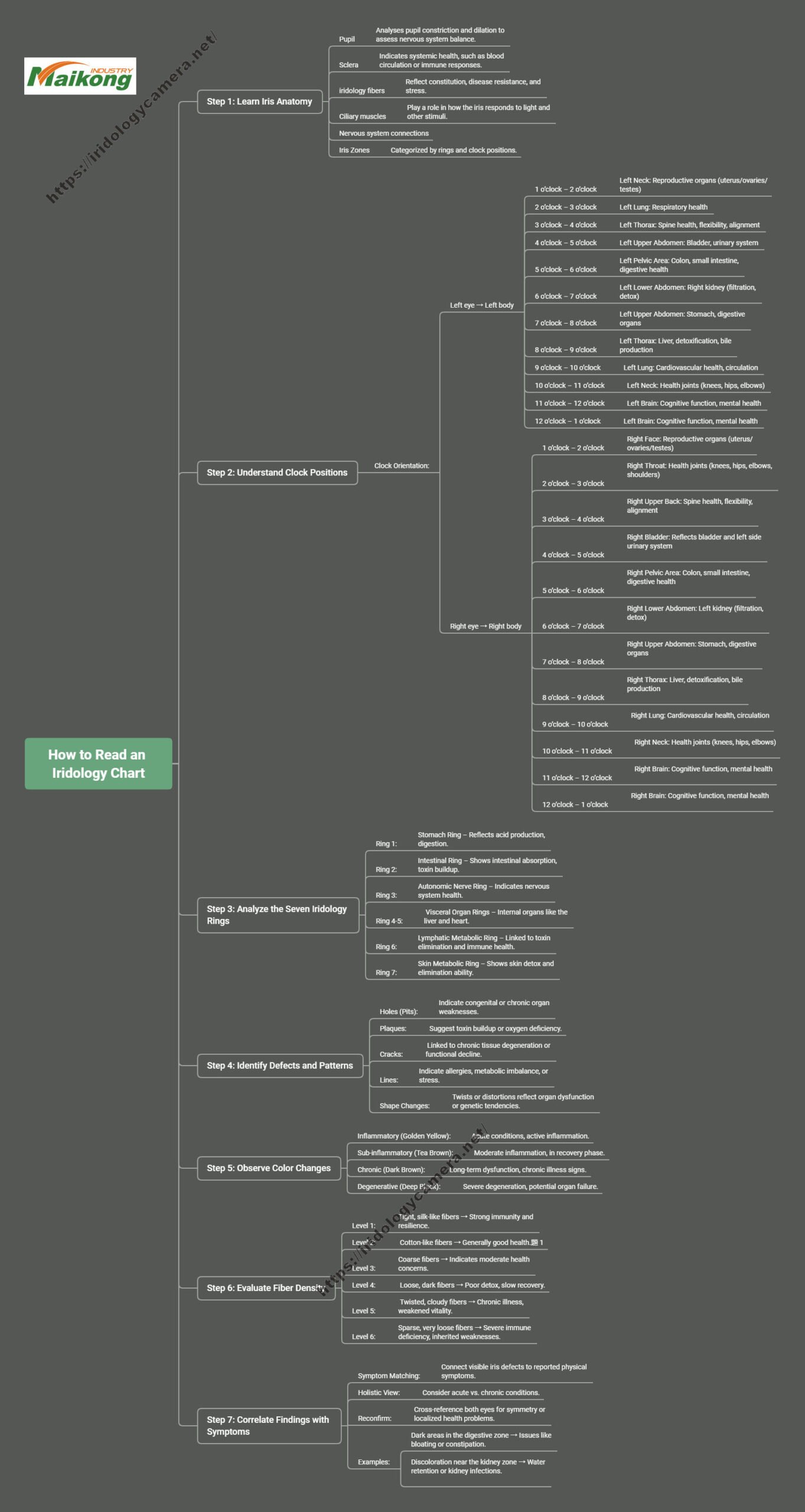
Step 1: Learn Iridology Anatomy and Structure
Iridology is divided into sections that reflect different organs and systems. To begin, I studyelev, sclera, și Iridology fibers, which provide essential clues.
Key Areas
Descriere
Scop
Elev
Central part eye
Helps assess nervous system reactions and stress.
Sclera
White part eye
Indicates immune response and systemic health.
Iridology Fibers
Colored fibers forme Iridology
Shows constitution, health resilience, or weaknesses.
Step 2: Understand Clock System and Organ Correlation
Iridology is mapped useclock system, where each hour position reflects different organ or system.ochi dreptrepresentspartea stângăbody, whileochi stângmirrorsright side.
Poziția ceasului
Right Eye (Organ)
Left Eye (Organ)
12-1 o’clock
Physiological Brain
Psychological Brain
1-2
Faţă
Gât
2-3 ora
Gât
Lungs
3-4 ora
Upper Back
Thoracic Cavity
4-5 ora
Lower Back
Upper Abdomen
5-6 ora
Pelvis
Lower Abdomen
Knowe these organ correspondences helps pinpoint concern dure Iridology examination.
Step 3: Analyze Seven Iridology Ring
Iridology is divided into7 Ring, each represente different physiological functions.
Re Number
Nume
Locaţie
What Reflects
1
Inel de stomac
At pupil-Iridology boundary
Stomach health and digestive function.
2
Intestinal Ring
Surrounde stomach Ring
Intestinal absorption and toxin elimination.
3
Autonomic Nerve Ring
Just outside intestinal Ring
Nervous system balance in controlle organs.
4-5
Visceral Organ Reflex Ring
Surrounde autonomic nerve Ring
Health major organs like liver, lungs, and heart.
6
Lymphatic Metabolic Ring
Between visceral and skin Ring
Detoxification and lymphatic efficiency.
7
Skin Metabolic Ring
Outermost Iridology Ring
Skin health and ability to eliminate toxins.
Step 4: Identify and Interpret Key Defects
Certaindefectsin Iridology, suchgăuri, cracks, și lines, provide critical insights.
Defect
Descriere
What Indicates
Holes (Pits)
Small depressions in Iridology
Weakness or chronic issues in corresponde organs.
Plaques
Flat, discolored areas
Toxin accumulation or poor oxygenation in tissues.
Crăpături
Irregular fissures
Long-term degeneration or imbalances.
Lines
Fine radial streaks
Allergies, poor metabolism, or nervous tension.
Step 5: Observe Color Changes and Stages Health
Iridology color changes reveal different stages inflammation and organ health deterioration.
Etapă
Culoare
Indication
Surface Appearance
Inflammatory
Golden Yellow
Active inflammation in affected organs.
Raised surface
Sub-Inflammatory
Tea Brown
Moderate inflammation below surface.
Sub-surface
Chronic
Maro închis
Reduced organ function and chronic conditions.
Sunken surface
Degenerative
Deep Black
Severe tissue degeneration or potential tumor formation.
Deeply sunken surface
Step 6: Evaluate Iridology Fiber Density
densityIridology fibers reflects person’simmune strength şi resilience.
Density Level
Descriere
Health Implications
Nivelul 1
Tight, silk-like fibers
Strong immunity and high disease resistance.
Level 2
Cotton-like density
Stable health with moderate resilience.
Level 3
Coarse, fabric-like
Weaker constitution, prone to chronic issues.
Level 4
Loose, linen-like fibers
Poor detoxification, chronic imbalances.
Level 5
Twisted, disorganized fibers
Chronic weaknesses and vulnerability to illness.
Level 6
Sparse, extremely loose fibers
Severe immune deficiency, often hereditary.
Step 7: Correlate Findes with Symptoms
Finally, I compare Iridology findes withclient’s symptomsto create holistic picture health. example, if I observedark areasin digestive zones and client reportsbloate or constipation, I can suggest further diagnostic or dietary changes.
Table 1: Six Key Iridology Phenomena
O perfectIridology h no cracks, holes, or twisted fibers. shows even color and structure, similar to new piece silk fabric. When Iridology changes, often reflectsorgan dysfunction sau imbalance, indicate sub-health conditions. Below six key phenomena:
Phenomenon
Descriere
Impact on Health
1. Holes (Pits)
Appear three-dimensional. More holes suggest weaker constitution, often linked to genetic weaknesses.
Open pitseasier to treat, whileclosed pitsindicate more severe, harder-to-heal organ issues.
2. Plaques
Flat spots, often cause by long-term antibiotic use.
Common in weak or oxygen-deprived tissue areas, indicatetoxin buildup sau reduced circulation.
3. Cracks
Visible irregular fissures.
Often linked toorgan degeneration, with symptoms such pain or reduced functionality.
4. Lines
Fine radial lines, often pale in color.
May indicateallergic tendencies, nervous tension, orpoor metabolism.
5. Color Changes
Iridology color shifts dure different health phases (see next table).
Reflects stagesinflamaţie şi organ decline.
6. Fiber Density
Iridology fibers categorized into six density levels (see density table).
Indicatesimmunity, muscle elasticity, și disease resistance.
Table 2: Iridology Color Changes by Disease Stage
Etapă
Culoare
Indication
Surface Appearance
Inflammatory
Golden Yellow
Indicates activeinflamaţiein body.
Raised surface
Sub-Inflammatory
Tea Brown
Less intense, showemoderate levelinflammation.
Below surface
Chronic
Maro închis
Reflectsorgan dysfunctionor reduced capacity.
Sunken surface
Degenerative
Deep Black
Suggestssevere organ damageand possible tissue degeneration or tumor formation.
Deeply sunken
Table 3: Iridology Fiber Density Levels
Fiber density in iridology reveals person’simmunity, resilience, și ability to recover. Variations indicate different constitutional strengths.
Level
Descriere
Health Implications
Nivelul 1
Tight, silk-like fibers
Strong immunity, resilience, and high disease resistance.
Level 2
Cotton-like density
Generally good health, moderate resilience.
Level 3
Coarse fabric-like
Weaker constitution, potential chronic or stress-related health issues.
Level 4
Linen-like, darker fibers
Poor resilience, may indicate long-term imbalances.
Level 5
Twisted, loose fibers
Indicateschronic weaknesses; disorganized fibers suggest poor detoxification and health challenges.
Level 6
Sparse, extremely loose
Reflectssevere immune deficiency sau inherited disorders, with high vulnerability to illness.
Table 4: Seven Iridology Res
Each re around Iridology corresponds to specific system in body. From pupil outward,seven Iridology resprovide insight into organ function.
Re Number
Nume
Locaţie
What Reflects
1
Stomach Re
At pupil-Iridology boundary
Reflectsstomach health, digestion, and acidity levels.
2
Intestinal Re
Outer third Iridology
Indicatesintestinal absorption, elimination, and toxin processe.
3
Autonomic Nerve Re
Just outside intestinal re
Shows balance betweennervous system regulationand internal organ function.
4-5
Visceral Organ Reflex Res
Outside autonomic nerve re
Reflects conditionsinternal organssuchliver şi inima.
Reflects healthskinand its ability to eliminate waste.
Table 5: Iridology Clock Positions and Organ Correlation
In iridology, each clock position Iridology relates to specific organs. Memorize these helps identify health issues with precision.
Poziția ceasului
Right Eye (Organ)
Left Eye (Organ)
12-1 o’clock
Physiological Brain
Psychological Brain
1-2
Faţă
Gât
2-3 ora
Gât
Lungs
3-4 ora
Upper Back
Thoracic Cavity
4-5 ora
Lower Back
Upper Abdomen
5-6 ora
Pelvis
Lower Abdomen
6-7 ora
Lower Abdomen
Pelvis
Ora 7-8
Upper Abdomen
Lower Back
8-9 ora
Thoracic Cavity
Upper Back
Ora 9-10
Lungs
Gât
Ora 10-11
Gât
Faţă
11-12
Psychological Brain
Physiological Brain
Tips Learne Iridology
Tip
Advice
1. Memorization
Familiarize yourself with Iridology -organ map and seven res.
2. Practical Study
Observe multiple Iridology cases to reinforce your understande patterns and signs.
3. Holistic View
Analyze both left and right Iridology together to get complete health overview.
These tables provide comprehensive guide to mastere iridology step by step.
Conditions Detected Through Iridology Reading
By examining the iris, practitioners can identify early signs of varioushealth conditions. This non-invasive method provides insights into systemic imbalances, helping to address potential issues before they escalate. Below, we explore specific conditions that may be detected through iris analysis.
Hypertension and Cardiovascular Issues
Concentric rings in the iris are often linked to hypertension risk. These patterns may indicate increasedbloodpressure or arterial plaque buildup. Early detection allows for proactive measures to prevent cardiovascularboală.
Liver and Gallbladder Problems
Scleral yellowing is a common sign of gallbladder dysfunction. Discoloration in the liver zone of the iris may also suggest stress or toxicity. Identifying thesesignscan guidetreatmentand lifestyle adjustments.
Digestive System Disorders
Radial furrows near the pupil often point to gastric inflammation. Discoloration in the digestive zone may indicate conditions like leaky gut syndrome. Addressing theseproblemsearly can improve overall digestive health.
Inflammation and Immune System Health
“Rozariu limfatic” patterns in the iris are associated with immune suppression. Changes in iris topography may predict autoimmune flare-ups. Monitoring thesesignshelps in managing chronicboalăand supporting immune function.
Semnul Iris
Potential Condition
Concentric Rings
Hypertension
Scleral Yellowing
Gallbladder Dysfunction
Brazde radiale
Gastric Inflammation
Rozariu limfatic
Immune Suppression
Controversies and Criticisms of Iridology
Lectură de iridologie-While iridology has gained attention, its validity remains a topic of debate. Critics argue that thepracticalacks scientific backing, while supporters believe it offers valuable health insights. This section explores the controversies surrounding iridology, including its scientific validity, common misconceptions, and potential risks.
Scientific Research and Validity
Numerousstudieshave questioned the accuracy of iridology. A 1979 JAMA study found 0% accuracy in detecting kidney disease. Similarly, a 2005 Münstedt trial showed no correlation between iris patterns and cancer. These findings challenge the reliability of iridology as a diagnostic tool.
Edzard Ernst’s 2000 review of 77studiesconcluded that iridology lacks consistent evidence. While some practitioners claim the iris reflects systemic health,researchsuggests otherwise. This raises concerns about its use in clinical settings.
Common Misconceptions
One widespread belief is that the iris provides fixed genetic indicators, known as “iris constitutions.” However, biometric studies show that the iris remains stable over time, contradicting claims of diagnostic changes. This undermines the idea that iris patterns can predict health trends.
Another misconception is that iridology can replace traditional medicaldiagnosis. While it may offer supplementaryinformation, it should not be used as a standalone diagnostic method. Relying solely on iridology can lead to inaccurate conclusions.
Potential Risks and Misdiagnoses
One major risk is delayeddiagnosisof serious conditions like cancer. Patients may rely on iridology instead of seeking medical advice from adoctor. This can result in untreated illnesses and worsened health outcomes.
Additionally, iridology often leads to unnecessary supplement regimens. Patients may spend money on treatments for conditions they don’t have. This highlights the need for regulatory oversight in thepracticaof iridology.
In the U.S. and Canada, certification for iridologists is largely unregulated. This lack of oversight increases the risk of misdiagnosis and unethical practices. Patients should approach iridology with caution and consult licensed healthcare providers for accuratediagnosis.
Concluzie
Înțelegerea eye’s role in health assessment can open new perspectives. While analyzing iris patterns may offer insights, it should never replace traditional medical diagnostics. A 2015 Australian government review found no evidence supporting its accuracy, and iris recognition technology disproves theories of structural changes overtime.
We recommend using this method as a supplemental tool alongside evidence-based practices. For actionable results, consult adoctoror ophthalmologist, especially for scleral changes. Annual eye exams remain the gold standard for preventive care, ensuring early detection of potential issues.
By integrating holistic approaches with modern medicine,patientscan achieve a balanced perspective on theirhealth. Always prioritize proven methods for accurate diagnosis and effectivetreatment.
FAQ
Ce este iridologia?
Iridology is a practice that examines the iris to identify potential health conditions. It is based on the idea that changes in the iris can reflect issues in different parts of the body.
How does iridology work?
Practitioners use tools like magnifying lenses and specialized charts to analyze the iris. They look for patterns, colors, and markings that may indicate health concerns.
What conditions can iridology detect?
It is believed to identify issues like hypertension, liver problems, digestive disorders, and immune system imbalances. However, its effectiveness is debated in the medical community.
Iridologia este dovedită științific?
While some studies explore its potential, iridology lacks widespread scientific validation. Many medical professionals consider it a complementary tool rather than a diagnostic method.
Are there risks associated with iridology?
Misdiagnosis is a potential risk if relied upon exclusively. It is essential to consult a licensed healthcare provider for accurate diagnosis and treatment.
What tools are used in iridology?
Practitioners often use magnifying lenses, cameras, and iridology charts to examine the iris and interpret its markings.
Can iridology replace traditional medical diagnosis?
No, iridology should not replace conventional medical practices. It is best used as a supplementary tool alongside professional healthcare advice.
Address:Factory Building II, Jinshanlong Industrial Park, No.1, Xintang Village, Kratong Community, Fucheng Street, Longhua District shenzhen, 518000 GD,China
TEL:0086-0755-888-56563
Person to contact:Mark Luo
email:lucy@iriscope.org
Whatsapp/phone:0086-191-5490-1065
Copyright (c) 2004-2024 www.iriscope.org All Rights Reserved.