1)iridology definition from David J. Pesek, Ph.D.,
![8789304_orig[1]](https://iriscope.org/wp-content/uploads/2017/08/8789304_orig1-1024x682.jpg "8789304_orig[1]ition 1")
Čo je iridológia
“The Iris, Sclera and Pupil of the eye show the veil the soul has created, through consciousness (or forgetfulness), that reflects the illusion which prepares the soul for attaining the reality of full enlightenment.”
~David J. Pešek, Ph.D., september 1988
An Introduction
Oči boli dlho označované ako “Okná duše.” Ale len málo ľudí si uvedomuje, nakoľko je toto pozorovanie pravdivé. Presná analýza štruktúry a pigmentácie dúhovky poskytuje informácie o vás alebo vašich klientoch, ktoré je ťažké nájsť inými metódami. Tieto informácie sú také cenné, že si iridológia zaslúži, aby sa stala široko používaným hodnotiacim nástrojom v oblasti fyzického aj psychologického zdravia. Existuje množstvo faktorov, ktoré ovplyvňujú naše zdravie a osobnosť, a mnohé z týchto faktorov sa odrážajú v dúhovke. Pozrite sa pozorne na svoje oči v zrkadle a potom na dúhovky ľudí okolo vás. Uvidíte veľa rôznych vzorov vlákien dúhovky a farieb. Rovnako ako odtlačky prstov alebo tváre, žiadne dva nie sú úplne rovnaké a ani my nie! Štruktúra dúhovky je taká jedinečná; teraz sa používa na bezpečnostnú identifikáciu v bankomatoch a na letiskách. Dom budúcnosti Microsoftu použije očný skener na identifikáciu obyvateľov a odomknutie dverí.
What is it?
Iridológia je založená na vedeckom štúdiu dúhovky — farebná časť oka. Podobne ako značky na mape, dúhovka odhaľuje fyziologické stavy, psychologické zdravotné riziká, výzvy a/alebo silné stránky rôznych orgánov a osobnostné črty.
Prostredníctvom iridológie môžeme získať pochopenie vášho minulého, súčasného a potenciálneho budúceho zdravotného stavu hodnotením rôznych systémov tela. Odhalia sa aj vaše zdedené sklony spojené s hromadením toxických látok v rôznych častiach vášho tela.
Veda o iridológii je založená na analógii jednej z najkomplikovanejších tkanivových štruktúr celého tela – dúhovka.
Je to metóda, pomocou ktorej môže lekár alebo zdravotník zo znakov alebo znakov na dúhovke zistiť reflexný stav rôznych orgánov a systémov tela. Tieto označenia predstavujú podrobný obraz integrity tela; ide o konštitučné potenciály, oblasti preťaženia alebo akumulácie toxických látok a inherentné výzvy a dary.
Štyri princípy, ktoré tvoria základné kamene iridológie, sú:
- Stav nervov
- Stav krvi a lymfatického systému
- Primeraný obeh
- Výživa – kvalita odpočinku, dýchanie – stav mysle
Príroda nám poskytla neoceniteľný pohľad na vitálny stav zdravia tela prenosom týchto informácií do oka.
Laboratórne testovacie postupy používané v súčasnosti, ktoré nie sú vždy potrebné, sú drahé, časovo náročné a pre pacienta často nepohodlné. S iridológiou máme jednoduchý, bezbolestný, ekonomický a neinvazívny spôsob pohľadu do tela. To neznamená, že by to malo vylúčiť iné formy analýzy. Naopak, môže sa použiť v spojení s akýmkoľvek iným systémom analýzy alebo diagnózy, ktorý chce odborník použiť. Teraz, viac ako kedykoľvek predtým v histórii, potrebujeme presné a menej zložité prostriedky na analýzu stavu pacienta.
Osemdesiat percent ochorení, ktoré sa v tejto krajine liečia, je chronického charakteru. Tkanivo nájdené u chronicky postihnutých pacientov sa dá lepšie monitorovať v očnej dúhovke ako možno akoukoľvek inou metódou analýzy.
Iridológia poskytuje základný pohľad na vývoj týchto chronických ochorení alebo na zmiernenie tohto ochorenia alebo zápalu.
Veda o iridológii je založená na analýze jednej z najkomplikovanejších tkanivových štruktúr celého tela – dúhovky. Iridológia ponúka jedinečný pohľad na koncepciu a prax preventívnej zdravotnej starostlivosti. Zahŕňa neinvazívny diagnostický postup, ktorý bežne používajú európski lekári a môže byť užitočný pri zisťovaní existujúcich stavov, ako aj dedičných genetických slabostí. Je známe, že do zrakového nervu sa dostáva približne 300 tisíc nervov z rôznych častí tela. Preto môže byť na dúhovke viditeľná projekcia systémovej aktivity.
A Brief History of Iridology
Iridologický výskum sa začal v roku 1670, keď Dr. Philippus Meyens publikoval článok popisujúci oči svojich pacientov, keď ochoreli alebo sa zranili. Všimol si aj zmeny v oku, ktoré prišli s uzdravením a dokázal prepojiť body na dúhovke s konkrétnymi časťami tela. Pozorovaním oka bol nakoniec schopný identifikovať oblasti v tele, ktoré potrebovali oporu, ktoré by sa v oku objavili dlho predtým, ako sa prejavia fyzické príznaky.
Zatiaľ čo oči boli stredobodom pozornosti civilizácií po celé veky, “moderné” Iridológia začala pred viac ako 100 rokmi. Koncom 19. storočia začali jeden lekár z Maďarska a ďalší zo Švédska pozorovať oči a organizovať svoje zistenia. Tento proces pozorovania a korelovania bol pomalý, ale vytvoril základ pre ostatných, na ktorých môžu stavať. Prvá kniha o iridológii v Amerike od emigrovaného rakúskeho lekára bola vytlačená v roku 1904. Potom nasledovali práce N.D.s a iných naturopaticky orientovaných M.D.s.
Pri práci s obmedzeným zväčšením a fotografickým vybavením bol pokrok ťažký. Potom so vznikom AMA a ďalších politických a ekonomických vplyvov a nástupom “zázrak” drog, takmer všetky praktiky prírodnej medicíny v tejto krajine upadli. Dr. Bernard Jensen sa zaslúžil o to, že udržal iridológiu pri živote v Severnej Amerike.
V Európe vytvorila odlišná politická a ekonomická klíma prostredie, ktoré umožnilo rozvoj iridológie (a iných postupov prírodnej medicíny). V Európe sa uskutočnil rozsiahly výskum a iridológia je teraz široko akceptovaná ako hodnotný preventívny prístup k zdravotnej starostlivosti. V súčasnosti v USA viac ľudí prejavuje záujem o iridológiu ako alternatívnu metódu na zlepšenie zdravia. Teraz môžete zažiť výhody tohto pozoruhodného hodnotiaceho nástroja/techniky.
Aké sú výhody iridológie?
Iridológia lieči osobu namiesto symptómov. Vďaka pochopeniu svojich genetických zraniteľností a reaktívnych vzorcov si môžete udržať rovnováhu a chrániť sa pred chorobami. Telo má svoju vlastnú liečivú múdrosť, ak má príležitosť. Iridológia ponúka jednoduchý ekonomický spôsob, ako sa naučiť starať o svoje telo.
Základným cieľom iridológie je prevencia závažných degeneratívnych procesov integráciou nutričnej, mechanickej (chiropraktickej), duchovnej a emocionálnej podpory. Niektoré z výhod iridológie sú:
- Celkové povedomie o zdraví
- Pochopenie interakcie orgánov
- Vedieť, ktoré orgány sú pod alebo naopak príliš aktívne
- Oboznámenie sa s celkovou chémiou tela
- Poznať stavy nervového, tráviaceho, vylučovacieho, lymfatického a štrukturálneho systému tela.
Schopnosti:
- Špinenie zápalu. Ukáže, kde je prítomný zápal.
- Odhaľuje oblasti v tele, kde sa kyslosť hromadí alebo môže hromadiť.
- Úrovne telesnej aktivity. Ukáže, či je niektorá časť vášho tela príliš aktívna alebo málo aktívna.
- Problémové špinenie. Ukáže, kde sa vo vašom tele vyskytujú problémy.
Práve táto zmena tkaniva, ku ktorej dochádza u pacienta, robí iridológiu obzvlášť cennou pre tých, ktorí sa špecializujú na liečbu chronických ochorení.
Rovnica zdravotného stavu
Aby sme plne ocenili to, čo dúhovka odhaľuje, zvážme najprv túto rovnicu:
ZDRAVOTNÝ STAV = FYZICKÉ DEDIČSTVO + PROSTREDIE (Strava, životný štýl a pod.) + EMOČNÉ/DUCHOVNÉ FAKTORY + VEK.
Všetci dedíme určité kombinácie fyzických vlastností. Niektoré z týchto pôvodov môžeme pozorovať z nášho rodokmeňa, ale ako veľmi sa to týka vás? Diéta a životný štýl majú na niektorých ľudí veľký vplyv, ale prečo sú iní schopní vyhnúť sa zneužívaniu svojho tela? Ktoré mentálne a emocionálne aspekty výrazne ovplyvňujú naše fyzické zdravie? A ako starneme, strácame svoju odolnosť rôznym tempom.
Aká je naša individuálna miera?
Iridológia odstraňuje z týchto otázok veľa dohadov. Prechádzať životom bez týchto informácií je ako vydať sa na výlet bez mapy. Aké sú vaše šance dostať sa do požadovaného cieľa? Dostanete sa tam efektívne, alebo to skončí tak, že po ceste budete veľa odbočovať? A ako budete vedieť, kam sa chystáte nabudúce?
Pomocou cestovnej mapy alebo plánu obsiahnutého v dúhovke môžete zistiť, ako dobre ste poskladaní (a koľko zneužívania vaše telo dokáže zvládnuť), kde má vaše telo tendenciu ochorieť (vrátane toho, ktoré orgánové systémy sú vystavené väčšiemu riziku), aké konkrétne základné dôvody prispievajú k vašim symptómom (ktoré sa môžu líšiť od osoby k osobe s rovnakými príznakmi) a aké emocionálne alebo behaviorálne faktory ovplyvňujú tieto vzorce. Stručne povedané, môže vám ukázať, odkiaľ ste prišli, kam máte namierené, akú máte karosériu vozidla a aký typ vodiča ste. S týmito znalosťami môžete efektívnejšie pristupovať k zdravotným problémom a tiež identifikovať, ktoré postupy preventívnej medicíny by boli pre vás najdôležitejšie.
Iridológia sa zaoberá jednou z najzákladnejších právd liečiteľských umení, s ktorou sa priemerná forma analýzy poriadne nezaoberala.
Percento nesprávnej diagnózy je teraz takmer také veľké ako v 20. rokoch minulého storočia v dôsledku nárastu symptómov ochorenia. Tento nárast spolu s kombináciami reakcií spôsobených röntgenom, sulfátom a inými liekmi a naším pokračujúcim používaním rafinovaných a syntetizovaných potravín sťažuje presnú diagnostiku. Zmeny v životných návykoch, znečistenie a zvýšený stres modernej doby menia aj prejavy rôznych príznakov chorôb. Na základe týchto skutočností je zrejmé, že samotná symptomológia často nestačí poskytnúť diagnostikovi dostatok informácií na plánovanie správnej liečby pacienta.
Iridológia ponúka jedinečný pohľad na koncepciu a prax preventívnej medicíny. Pomocou ortodoxných metód analýzy a diagnostiky je ťažké upozorniť človeka na zdravotné problémy, ktoré bude mať jeho telo. Tieto metódy sa spoliehajú na objavenie sa klinických symptómov. Dúhovka však môže naznačovať problém vo svojom najskoršom počiatku, dlho predtým, ako sú prítomné symptómy ochorenia. Na základe týchto informácií je možné vypracovať zdravotný program, ktorý je prispôsobený špecifickým potrebám klienta, čím sa predchádza prejavom ochorenia.
Zoskupenie zoznamu symptómov do názvu choroby s cieľom identifikovať a podať liek, ktorý tieto symptómy potláča, nie je uspokojivým riešením problému zdravotnej starostlivosti a údržby. Iridológia vo svojej základnej filozofii kladie dôraz na liečbu pacienta, nie choroby. Identifikácia základných nerovnováh v tele, ktoré spôsobujú symptómy, je neoceniteľným prínosom pri formulovaní liečebných terapií.
Keď si človek plne uvedomí hodnotu schopnosti určiť zvonku tela, čo sa v ňom deje, uvedomí si, že iridológia je skutočne veda, ktorej čas prišiel.
Iridologické hodnotenie
V oku sa odohráva príbeh, ktorý zobrazuje detailný obraz tela pri práci, zdraví a chorobe. Oči sú predĺžením mozgu. Sú vstupom pre mozog. Prostredníctvom zmien v pigmentoch a štruktúre dúhovky sa odhaľujú abnormálne stavy tkaniva v tele.
Iridológia je najefektívnejšia hodnotiaca technika na svete, ktorá zohľadňuje človeka ako celok. Ľudstvo treba študovať ako celok, pretože celok je viac ako súčet jeho častí. Najúčinnejšia reakcia na zvýšenie úrovne zdravia pochádza z implementácie analýzy výživy a dúhovky. Okrem nutričnej terapie môžu byť do liečebného plánu každého jednotlivca zahrnuté rôzne prírodné terapie.
Prečo Iridologické vyšetrenie? Správa vášho zdravia je v konečnom dôsledku na vás. Najmúdrejší spôsob, ako chrániť svoje zdravie, je dôkladne poznať a porozumieť svojmu telu. Keď sa staráte o svoje telo, vašou odmenou je wellness. Cítite sa a vyzeráte mladšie. Zažijete viac energie a nadšenia. Iridologické vyšetrenie vám poskytuje informácie o signáloch vášho tela a o tom, ako na ne môžete reagovať. Určité stavy možno zistiť skôr, ako spôsobia vážne problémy, čo vám umožní “utlmiť to v zárodku.”
Ak trpíte niektorým z nižšie uvedených príznakov, iridologické vyšetrenie je vysoko účinný nástroj, ktorý vám pomôže určiť príčinu (príčiny):
- Katar
- Zápcha
- Migréna
- Nespavosť
- Kožná erupcia
- Infekcie
- Artritída
- Depresia
- Nízka energia
- Výboje
- Astma
- Alergie
- Kolika, hnačka
- Horúčky, prechladnutie, chrípka
- Chronická únava
- Senná nádcha
Najväčšou črtou a hlavnou výhodou ústavnej iridológie oproti formám zdravotného skríningu je, že dúhovka odhaľuje potenciály a tendencie, ktoré sa môžu vyskytnúť, ak človek žije svoj život určitým spôsobom. Preto môžu byť symptómy liečené desaťročia predtým, než sa vôbec objavia. Je možné prijať preventívne opatrenia na zlepšenie zdravia a predchádzanie chorobám, ktoré by inak mohli nasledovať.
2)iridologický graf význam
IRIDOLOGY & SCLEROLOGY
Each eye reveals different information. The left iris correlates to the organs, glands, tissues & other structures located on the left side of the body. The left side also controls the feminine, creative, conceptual & intuitive aspects of our personalities.
The right iris correlates to all of the anatomical structures on the right side of the body, as well as indicating the masculine, practical, analytical & logic aspects of our being.
More than just detecting the condition of present physical health & the exact location & stage of conditions, Iridology will accurately reveal potential problems twenty years or more in advance, as well as physical transitions due to toxicity, weakness or deficiency & past injuries or conditions. Emotional & mental patterns & attitudes & hereditary strengths & weaknesses also appear.

Cholesterol ring:
This sign presents as white halo around the perimeter of the iris. It may indicate a family history of heart disease.
Go for a cholesterol check.
Orange tones:
A deep orange colour surrounding the pupil can be a sign of disordered sugar metabolism.
If the eye turns a deep red & you have throbbing pain at the front, this could be iritis or — inflammation of the iris, the colored part of the eye. This is triggered by an over-reaction of the immune system, though its exact cause isn’t known. The redness tends to start at the centre of the eye & spreads in a red ring around the center within 24 to 48 hours. It doesn’t usually spread to the other eye.
A coppery-colored ring round the eye can be a sign of Wilson’s disease, a rare genetic disorder which causes too much copper to build up in the body. Untreated it can cause damage to the liver & brain.
Pupil reflex:
If a pupil does not contract when a bright light shines on to it, this indicates dulled nerve reflexes, weak adrenal glands or an overstimulated sympathetic nervous system, often from fear as a hidden, chronic condition.
Adrenal stress is indicated if the pupils begin to expand & contract repeatedly when exposed to bright light for 30 seconds.
Nerve wreath:
A strong, white & almost circular outline of the intestinal area – the nerve wreath – indicates a good condition of the autonomic nervous system.
If this outline is weak, jagged, discolored, or extends far towards the periphery or the pupil, we may assume the autonomic nervous system is in a poor condition.
The normal position of the nerve wreath is one-third the distance between the pupil & the periphery; if the nervous system is tense & overactive, the wreath is closer to the pupil & if the nervous system is relaxed & under-active it is closer to the periphery.
Nerve rings:
White circles or arcs of circles in the outer part of the iris. They indicate a tense, over-reactive, irritated nervous system.
The outermost iris zones represent the lymphatic & circulation system & bordering the sclera, the skin.
Discolored stomach area:
In a normal condition the stomach area is not visible, but if the stomach is irritated the area bordering the pupil will be whitish & distinct from the intestinal area.
A brownish discoloration of the stomach area indicates a chronic weakness.
Discolored intestinal area:
A whitish intestinal area indicates inflammation, irritation or ulcers.
If there is a mucous congestion in the head, there is a whitish or brownish discoloration in the transverse colon area, radiating towards ear & brain.
If chronically weak, this area will be dark.
Radial black lines:
When there is a serious deterioration of the intestines, strong black lines (radii solaris) will develop, starting from the pupil & radiating towards the periphery.
Organs through which these radii pass will be very weak as well.
Unusual markings:
Distinct markings may be colored brown, red or yellow. Unusual colors indicate deposits of drugs or other chemicals that settle in weak organs.
White outer ring:
A heavy white ring near the outer edge of the iris points to salt (sodium) & calcium deposits.
Bluish-white film:
A bluish-white film beginning to cover the iris from the outer rim indicates poor circulation to this area & an anemic condition.
Often this film appears in the brain area, indicating approaching senility (arcus senilis).
Dark outer ring:
A dark ring at the outer rim (scurf rim) shows the skin is inactive with accumulated wastes & needs frequent stimulation, better circulation & improved kidney & lung activities.
Lymphatic rosary:
A series of white spots near the outer rim, the ‘lymphatic rosary’, indicates chronic infection & congestion of the lymphatic system. Avoid especially lactose & cows milk products (except butter).
SCLEROLOGY
Sclerology is defined as the interpretation of the red lines in the whites of the eyes and their meaning for health evaluation & analýza.
The various signs, markings, shapes & colors in the sclera allow to evaluate the current state of health as well as inherited tendencies & the sings can show way before the symptoms arise or before blood test findings (up to 13 months in advance).
Sclerology may show that the function of an organ is disturbed, but not whether it is overactive or under-active.
Generally a blood vessel pointing towards a certain organ reflex in the iris indicates that there is something wrong with that organ or part of the body.
The stronger the blood vessel is visible & also the more of them are bunching together, the worse is the problem.
A bluish color of the sclera indicates under-activity.
Compare the lines to a Sclerology chart. Determine what parts of the body need attention based on the information from the chart.
The sclera can turn yellow when the body has high levels of bilirubin in it. This can be caused by blood diseases or by liver diseases.See a doctor right away, as jaundice can be a sign of several serious health problems, including liver dysfunction, hepatitis & in rare cases, pancreatic cancer.
When the sclera turns blue, it can be a sign of a syndrome called osteogenesis imperfecta, a disease that makes the bones very brittle.
Light blue sclera can be sign of lack of calcium.
Viruses or localised infections can cause the eye to redden — the problem usually starts in one eye, but can spread to both.
If they look grayish: It’s probably just a result of the natural aging process, which can make the whites of the eyes become grayer. Also there are some serious medical conditions that can turn the whites gray, including rheumatoid arthritis & brittle bone syndrome.
If one eye suddenly becomes red without any other symptoms, then it could be a subconjunctival hemorrhage — where blood leaks in the thin layer of skin at the front of the eyeball. This is very common, particularly in older people. It can be brought on by a violent coughing fit, vomiting, or if you are prone to nose bleeds or bruising. It should clear up by itself within a couple of weeks.
If they look red: Most likely, your eyes are dry. Those red squiggles you see are tiny blood vessels, which become more prominent when eyes are irritated. It can be a result of age, staring at the computer, or environmental factors, like air-conditioning.
Toxic liver.
Persistent red blotches on the whites of both eyes can be a sign of hypertension. High pressure causes the blood vessels to expand or even burst, leaving red marks across the white of the eye (but not the colored part).
Red veins on the eye whites may be sign of high blood pressure.
White discharge from the corner of the eye-could be digestive problems.
Small yellow dots,look like bits of dough,around & on the eyelids can be sign of high cholesterol or liver cirrhosis.
Red upper eyelids-gastritis.
Blind spot accompanied with flickering lights or wavy lines-Ocular migraine (may lead to loss of vision)
Bloody eye,sclera has red spots -high blood pressure, clotting disorder
Brown spots, a bump with blood vessels, often on the lower eyelid -tumor (abnormal growth which may be cancerous)
Bug eyes,bulging eyes with swollen eye tissue -It’s a common sign of Grave’s disease, a.k.a. overactive thyroid. In addition to the bug-eyed look, people with Grave’s often experience weight loss, nervousness & a rapid or irregular pulse.
Bumpy yellowish patches,small yellow spots on the eyelid -high cholesterol
Burning eyes,stinging in the eyes with blurred vision during computer use-computer vision syndrome
Cloudy eyes,clouding of the lens with hazy vision-cataracts (may cause blindness)-the condition, which can be corrected with surgery, is most common in older people. Cataracts that arise in younger people can have a variety of causes, including tumors & diabetes, as well as side effects from certain medications.
Color confusion,reds & greens are unclear -color blindness
Crossed eyes,one or both eyes turn inwards -intra ocular tumor, neurological disorder
Double vision,seeing double images-stroke (sudden), Multiple Sclerosis
Droopy eyes,eyelids are droopy -brain tumor, neuromuscular disorder
Dry eyes,especially in 40+ women with autoimmune conditions & affecting the mouth such that absence of saliva makes chewing & swallowing difficult -Sjogren’s syndrome (immune cells damage tears & saliva producing glands).The menopause.
Golden brown or greenish yellow ring,colored ring on the cornea, surrounding the iris-Wilson’s disease (excess copper collects in tissues, may lead to liver disease)
Grey or milky-white colored ring on the cornea, surrounding the iris-which doctors call arcus senilis, often goes hand in hand with high cholesterol & triglycerides & an increased risk for heart attack & stroke. Anyone who has the condition should have a blood test to check for elevated blood lipids – especially people under age 60.
Increased eye-gunk,eyelid edges are red & itchy-dandruff, Acne rosacea
Large eye,one eye appears larger (generally in children)-glaucoma (damaged optic nerve), tumor, infection
Persistent stye,reddish lumps on the eyelid, present for more than 3 months-tumor, possibly cancerous
Pink eye,sclera is pink or light-red -conjunctivitis
Pupil size different,different size pupils & droopy eyelids -Horner’s syndrome (nervous system disorder), neck aneurysms (blood-filled bulge in blood vessel) & tumors.
Red, itchy eyes,along with sneezing, coughing, sinus congestion or runny nose -allergic reaction
Unable to close eyes or control tears ,often one side of the face is weak & droops-Bell’s palsy (facial paralysis due to dysfunctional cranial nerve VII)
Vanishing eyebrows,outer part of eyebrows disappear -thyroid disease (under active thyroid)
Yellow eyes,sclera is yellow -liver diseases such as jaundice, hepatitis & cirrhosis
Skin cancer-Basal cell carcinomas can show up in some pretty strange places, including the eyelid, where it often causes a sore that doesn’t heal & the loss of eyelashes. And it’s not something to be ignored. Although basal cell skin cancers are not usually fatal, they can cause severe disfigurement, blindness even death if they reach the brain through the eye socket.
3)Iridology Chart of the Right Eye Iris
Iridologická tabuľka dúhovky pravého oka
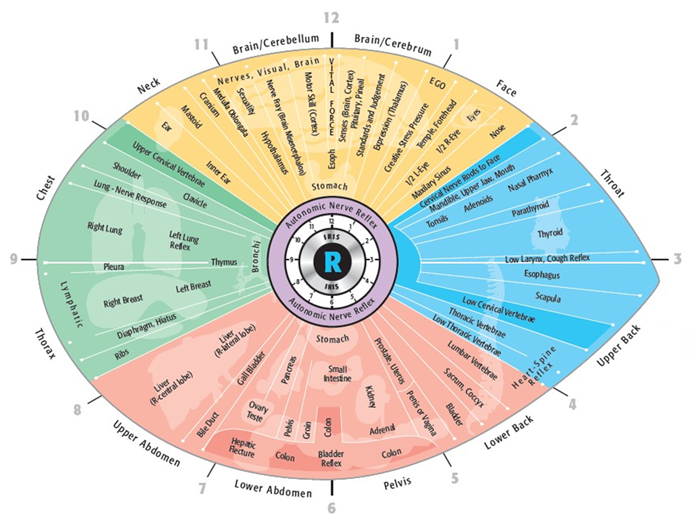
Iridologická tabuľka na tejto stránke zobrazuje zóny dúhovky pravého oka, pretože sa týkajú konkrétnych tkanív & orgánov v tele zo štúdií iridológie Dr. Jensona
Iridologická tabuľka nižšie dokumentuje zóny dúhovky pravého oka súvisiace s tkanivami a orgánmi v tele z mapovania zón iridológie Dr. Bernarda Jensona. Náš iridológ, ktorý študoval pod vedením Dr. Jensena, využíva iridologické tabuľky na identifikáciu možných slabostí v tkanivách a orgánoch tela.
Pravá dúhovka

Iridologická tabuľka dúhovky pravého oka
4)Iridology Definition
Iridológia, tiež nazývaná analýza dúhovky alebo diagnostika dúhovky, je štúdium dúhovky (farebnej časti oka). Iris “čítania” sú vytvorené iridológmi, aby zhodnotili zdravotný obraz človeka (fyzický, emocionálny, mentálny a duchovný) a viedli ho k prijatiu opatrení na zlepšenie jeho zdravia.
Origins
The basic concept of iridology has existed for centuries. The medical school of the University of Salerno in Italy offered training in iris diagnosis. A book published by Philippus Meyers in 1670, called Chiromatica medica, noted that signs in the iris indicate diseases. Dr. Ignatz von Peczely, however, is generally considered the father of iridology, with the date of his discovery given as 1861. Von Peczely was a Hungarian physician. As a child, he accidentally broke an owl’s leg. He observed that a black line formed in the owl’s lower iris at the time of the injury. After the owl’s leg healed, the young von Peczely noted that the black streak had changed appearance. As a physician, he treated a patient with a broken leg in whose eye he observed a black streak in the same location as on the injured owl’s iris. Von Peczely became intrigued by the possibility of a connection between diseases and eye markings. Through observing his patients’ eyes, he became convinced of this connection and developed a chart that mapped iris-body correlations. After several decades of comparative study, von Peczely mapped organs across zones identified by hours and minutes on a clock face superimposed over drawings of the eyes. In 1881, he published his theories in a book called Objavy v oblasti prírodných vied a medicíny: Návod na štúdium diagnostiky z oka.
A Swedish pastor and homeopath named Nils Liljequist also developed the concept of iris-body correlations at roughly the same time but independently of von Peczely’s work. He was the first iridologist to identify the effects of such drugs as iodine and quinine on the iris. Liljequist based his initial observations on changes in his own irises after illnesses and injuries, publishing writings and eye drawings during the late nineteenth century. One of his students, Dr. Henry Lahn, brought the practice of iridology to the United States. A variety of practitioners, primarily European, have sought to popularize iridology since these early works. Dr. Bernard Jensen, a chiropractor, is the best-known contemporary American advocate of iridology.
Prínosy
Iridologists claim that by studying the patterns of a person’s iris, they can provide helpful and accurate health and wellness information. Iridology is a holistic endeavor in that it addresses the person’s whole being in the reading. The range of information gleaned encompasses physical, emotional, mental, and spiritual aspects of the person’s health picture. In addition to assessing the person’s general level of health, readings can reveal other data, including energy quotients; internal areas of irritation, degeneration, injury, or inflammation; nutritional
and chemical imbalances; accumulation of toxins; life transitions; and subconscious tensions. Iridologists maintain that the eyes reveal information about the person’s physical and emotional constitution, such as inherited weaknesses and risks to which the person may be prone. Strengths may also be revealed, including inherited emotional tendencies from which the person derives particular talents. Cleansing and healing can be verified by changes in the iris. By looking for certain signs such as healing lines, iridologists obtain information about previous health problems and injuries and discover what may have gone wrong in the person’s past.
Iridologické čítanie odráža príčiny problémov, nie symptómy. Môže, ako tvrdia iridológovia, odhaliť, že orgány alebo systémy sú nadmerne zaťažené alebo náchylné na ochorenie ešte predtým, ako sa rozvinú klinické príznaky. Predpovedaním budúcich problémov možno iridológiu použiť ako preventívny nástroj. Ľudia môžu použiť informácie z iridologických meraní na zlepšenie svojho zdravia a na lepšie rozhodnutia v oblasti správania v budúcnosti, čím sa vyhnú problémom skôr, ako nastanú.
In North America, iridology is generally considered to be an assessment tool to be used in cooperation with other health specialties. Iridology is not a diagnostic tool (although it is more likely to be considered so by European iridologists) and should not be used to diagnose or name specific diseases. Not only would diagnosis represent an improper application of iridology according to many iridologists, as noted by the International Iridology Research Association (IIRA), it could also be construed in many countries as practicing medicine without a license.
Opis
Iridológia je vo všeobecnosti založená na koncepte nervových dráh medzi telom a dúhovkou. Aj keď sa iridológovia môžu líšiť v presnom mechanizme, väčšina tvrdí, že dúhovka odráža to, čo sa deje v tele prostredníctvom nervového vedenia zo všetkých častí tela do oka. Zdravotný stav klienta hodnotí iridológ, ktorý interpretuje vzory, tvary, prstence, farby a pigmentové znaky, vlákna, štruktúry a zmeny v zrenici a dúhovke. Mnoho iridológov používa pri hodnotení zdravotného stavu aj sklerológiu (čítanie čiar v bielej časti očí).
Iridology readings are typically performed by such holistically oriented practitioners as naturopaths, chiropractors, or nutritionists. The reading may be done using a bright light, a magnifying glass, and a notepad. The iridologist may also use various tools to better view the eye, a special camera to take pictures of the iris, and/or a computer.
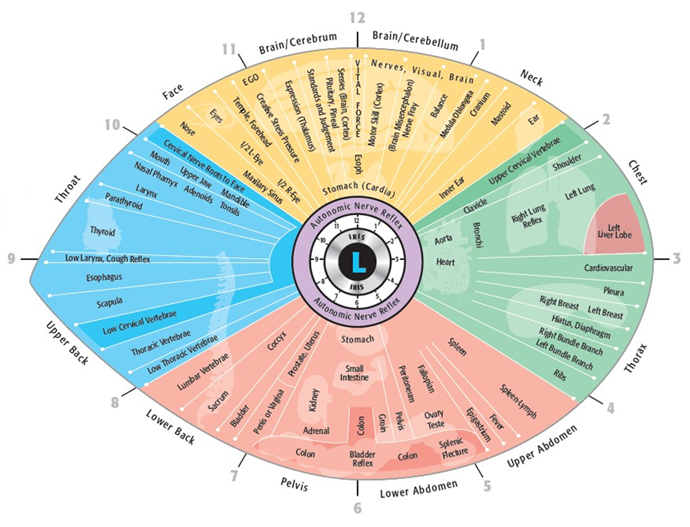
Iridologists conduct their readings using charts on which each area of the iris is mapped to a specific body system or organ. Iridology charts vary, with at least 20 different ones in existence. Some charts are more widely used than others; however, many iridologists believe that there is more than one correct map and that each practitioner should become familiar with several charts. Some iridologists even develop their own charts. Differences also exist among practitioner techniques; among American, European, and other approaches; and in the interpretation of specific iris signs.
Iridologické mapy rozdeľujú dúhovku do mnohých zón zodpovedajúcich rôznym častiam tela. Hoci sa špecifiká jednotlivých grafov môžu líšiť, všetky zdieľajú všeobecný vzor. Ľavé oko je mapované na ľavú stranu tela a pravé oko na pravú stranu. Horná časť oka je mapovaná k hornej časti tela (napr. mozog, tvár, krk, hrudník a srdce). Stred oka je mapovaný k žalúdku a tráviacim orgánom, pričom ostatné orgány predstavujú sústredné kruhové zóny pohybujúce sa smerom von k okraju dúhovky. Spodná časť oka je mapovaná na nohy a dolnú polovicu tela. Párové orgány (napr. obličky) sú mapované na obe dúhovky.
Using a holistic approach that considers each client as an individual with unique health patterns and concerns, behaviors, and experiences, the iridologist will examine the eyes and make a health assessment. Based on the results of that reading, the iridologist generally recommends a wellness program tailored to the individual’s physical, emotional, and life situation. This program may incorporate various health improvement, maintenance, and prevention regimes. Recommendations may include vitamins, minerals, herbs, supplements, and/or diet and nutrition , among other suggestions.
Preparation
No special preparations are necessary before an iridology reading.
Precautions
An iridology reading is unlikely to cause any physical harm by itself, as it does not involve direct contact with the eye or applying eye drops of any kind. Critics of iridology, however, argue that iridology can be detrimental to health if a sick person delays treatment for a condition not suggested by the iridology reading; or that it can can cause anguish and unnecessary expense if a reading suggests a problem when there actually is none.
Výskum & general acceptance
Rita M. Holl, RN, PhD, states that “Within Western medicine, iridology is considered a controversial science at best and medical fraud at worst.” Proponents of iridology argue that the practice is time-tested with proven results. Although critics acknowledge that certain symptoms of non-ocular disease do appear in the eyes (e.g., brain injury), there is, they argue, a lack of rigorous scientific testing and no evidence that iridology has any merit. Studies published in the Australian Journal of Optometry, the British Medical Journal, and the Journal of the American Medical Association (JAMA) have found iridologists’ assessment of patients with diagnosed serious diseases including kidney and gall bladder disease to be inaccurate. Iridologists counter that the research itself was faulty, citing problems including poor-quality photos; the absence of important additional information including the ability to see/interview the client; and inappropriate expectations of diagnosing specific diseases, a task outside the parameters of iridology. A more recent study conducted to reevaluate JAMA’s findings in regard to renal failure was published in the Alternative Health Practitioner. Acknowledging that the “study leaves several questions unanswered,” the author reported both similarities and variations in the iridologists’ readings and concluded that the iridologist’s level of expertise is extremely important as well.
Školenie & certifikácia
Iridologists receive training from various sources. They may learn their trade through books, tapes, correspondence courses, online classes, or live classes. According to the IIRA, “Iridológia pôsobí v šedej zóne v Severnej Amerike. Vo všeobecnosti neexistujú žiadne zákony, ktoré by definovali alebo regulovali túto prax. V Európe, najmä v Nemecku, je iridológia uznávaná a bežne používaná odborníkmi na prírodnú medicínu.” Aj podľa IIRA, “Pretože iridológia nemá žiadne oficiálne štandardy praxe, ktokoľvek sa môže nazývať iridológom, často s malým vzdelaním alebo skúsenosťami. Existujú tiež veľké rozdiely v informáciách o iridológii, ktoré sa vyučujú, najmä v Severnej Amerike.”
Zdroje
BOOKS
Jackson, Adam J. Iridology: A Guide to Iris Analysis and Preventive Health Care. Boston: Charles B. Tuttle, 1993.
Jensen, Bernard. Iridology: Science and Practice in Healing Arts, Vol. II. Escondido, CA: B. Jensen, 1982.
Jensen, Bernard. Čo je iridológia? Escondido, CA: B. Jensen, 1984.
Jensen, Bernard and Donald Bodeen. Visions of Health: Understanding Iridology. Garden City Park, NY: Avery Publishing, 1992.
Worrall, Russell S. “Iridology: Diagnosis or Delusion?” v Science Confronts the Paranormal, ed. Kendrick Frazier. Buffalo, NY: Prometheus Books, 1986.
ORGANIZATIONS
Canadian Neuro-Optic Research Institute. P.O. Box 29053. 4324 Dewdney Ave. Regina, Saskatchewan S4T 7X3. Kanada. (306) 359-7694. Fax: (306) 525-2659. cnricontacts@cnri.edu. https://www.cnri.edu/.
International Iridology Research Association. PO Box 1442. Solano Beach, CA 92075-2208. (888) 682-2208. IIRAOffice@aol.com. https://www.iridologyassn.org/.


![8789304_orig[1]](https://iriscope.org/wp-content/uploads/2017/08/8789304_orig1.jpg "8789304_orig[1]ition 1")