Iridologie und Kreislaufgesundheit: Entschlüsselung des Natriumrings Ein umfassender Leitfaden zu lymphatischen und vaskulären Zeichen in der Iris
Iridologie: Die Zirkulationszone
Iridologie-Die Iris, oft auch als bezeichnet “Mikrokosmos des Körpers,” bietet einen nicht-invasiven Einblick in die systemische Gesundheit. Unter seinen konzentrischen Zonen befindet sich der sechste Ring – allgemein als „der“ bezeichnet Zirkulationszone– verfügt über entscheidende Einblicke in die Gefäß- und Mikrozirkulationsfunktion. Eine deutliche Markierung innerhalb dieser Zone ist die Natriumring, manifestiert sich als vollständiger oder teilweiser weißer oder grauweißer Ring umgibt die Iris. Dieses Zeichen ist nicht nur eine oberflächliche Verfärbung, sondern ein deutlicher Hinweis darauf beeinträchtigte Mikrozirkulation, oft verbunden mit endothelialer Dysfunktion, oxidativem Stress oder Stoffwechselstörungen.
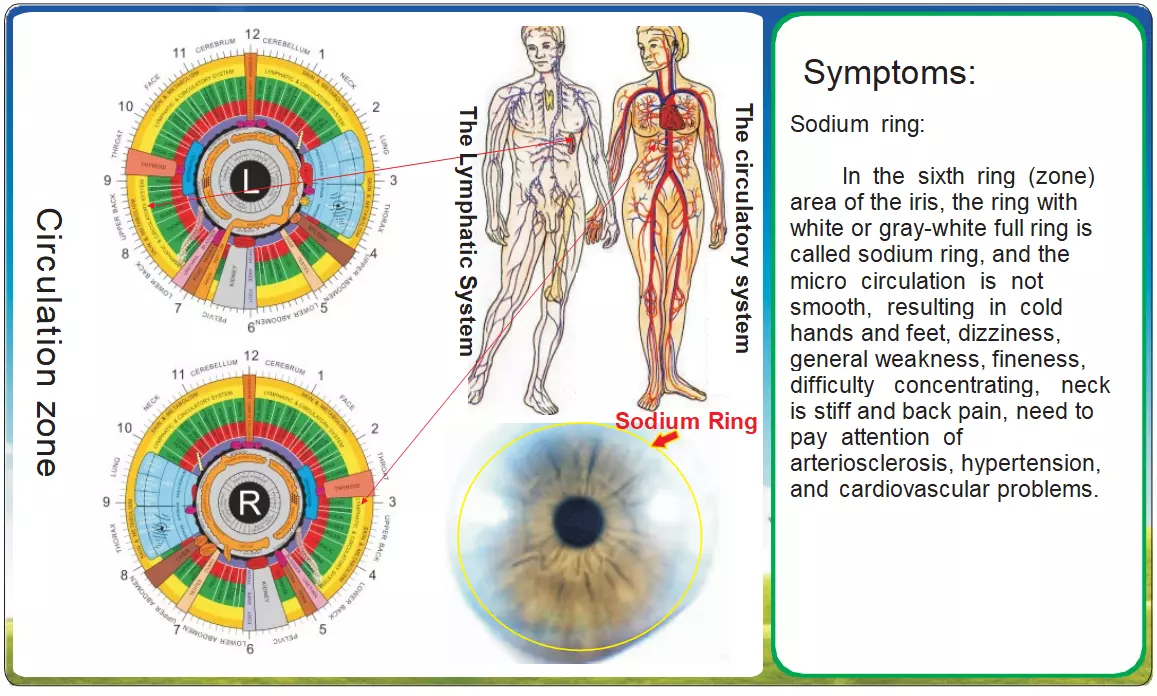
Das Lymphsystem in der Iridologie
Während das Kreislaufsystem für die Sauerstoff- und Nährstoffversorgung sorgt, fungiert das Lymphsystem als Abfallmanagementnetzwerk des Körpers und sorgt für den Flüssigkeitshaushalt und die Immunüberwachung. Obwohl lymphatische Zeichen im Vergleich zu vaskulären Markern in der Iris weniger direkt sichtbar sind, verschlimmert ihre Funktionsstörung häufig Durchblutungsstörungen. Zum Beispiel, Lymphstau kann eine venöse Stauung verstärken und zu folgenden Symptomen führen: lokalisiertes Ödem oder chronische Entzündung . In der Iridologie werden subtile Pigmentverschiebungen bzw “Lymph-Rosenkranz” (kleine weiß-gelbe Kügelchen in der Nähe der Irisperipherie) können auf eine lymphatische Beeinträchtigung hinweisen, insbesondere wenn sie mit systemischen Symptomen einhergehen.
Das Kreislaufsystem: Klinische Korrelationen
Die Anwesenheit des Natriumrings signalisiert chronische Mikrozirkulationsstörungen, die häufig auftreten mit:
- Kalte Hände und Füße aufgrund schlechter peripherer Durchblutung.
- Schwindel und Müdigkeit, was auf eine verminderte Gehirndurchblutung hindeutet.
- Nackensteifheit und Rückenschmerzen, möglicherweise verbunden mit einer Wirbelarterieninsuffizienz oder Muskelhypoxie. Diese Symptome erfordern Wachsamkeit Arteriosklerose, Bluthochdruck und Herz-Kreislauf-Erkrankungen, da anhaltende Mikrozirkulationsdefizite einer offensichtlichen Pathologie vorausgehen können.
Vergleichende Analyse von Systemen
| Aspekt |
Kreislaufsystem |
Lymphsystem |
| Primäre Funktion |
Sauerstoff-/Nährstoffzufuhr über Blutgefäße |
Immununterstützung, Flüssigkeitsdrainage |
| Iris -Indikator |
Natriumring (6. Zone) |
Lymphatischer Rosenkranz (periphere Iris) |
| Schlüsselsymptome |
Kalte Extremitäten, Schwindel, Bluthochdruck |
Schwellung, wiederkehrende Infektionen |
| Pathologische Risiken |
Arteriosklerose, Schlaganfall |
Lymphödem, chronische Entzündung |


